
VAT Modernisation: Implementation of eInvoicing in Ireland
On 8 October 2025, Revenue issued a press release and a paper on VAT Modernisation – Implementation of eInvoicing. In the paper Revenue set out details of the work it is undertaking to prepare for the implementation of the EU’s VAT in the Digital Age (ViDA) requirements.
The ViDA Directive, which leverages digital technology advances to modernise VAT systems across Europe, was adopted by the EU Council in March 2025 and has been agreed by all Member States. One of the key strands of the ViDA Directive relates to the introduction of eInvoicing between businesses, and real-time digital reporting by businesses to tax authorities. From July 2030, businesses that trade across EU borders will need to operate these new eInvoicing systems to maintain access to current 0% VAT arrangements that support Single Market trading.
To provide Irish businesses with adequate preparation time before ViDA becomes mandatory, Revenue will implement a phased rollout of eInvoicing requirements as follows:
-
Phase One – From November 2028, VAT-registered large corporate entities will be required to implement mandatory eInvoicing and real-time reporting for domestic business to business (B2B) transactions.
-
Phase Two – From November 2029, mandatory eInvoicing and real-time reporting for domestic B2B transactions will be extended to all VAT-registered businesses who engage in cross-border EU B2B trading.
-
Phase Three – From July 2030, mandatory eInvoicing and real-time reporting will apply to all cross-border EU B2B transactions.
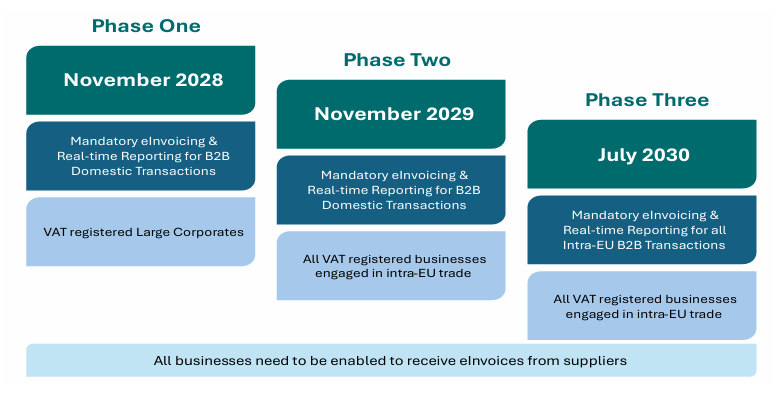
In addition to the above, all business will need to have the capability to receive eInvoices from November 2028. This includes business that are not required, under the phased roll-out, to issue eInvoices.
[Disclaimer: All reasonable effort was made to ensure that the information on this page was correct at the time of publication. Any views or opinions expressed on this page are not necessarily those of NSAI. NSAI accepts no responsibility or liability howsoever arising from the contents of this publication or any errors, inaccuracies, or omissions in the contents of the information provided therein.]